
152 Elizabeth St, Melbourne VIC 3000, Australia
Physical Termite Barrier Sydney | Chemical-Free Protection
Physical termite barriers
★★★★★ 5.0

Physical Termite Barrier Sydney

Need a physical termite barrier in Sydney that works without soil chemicals? Apex installs stainless steel mesh, graded stone, termite-resistant membranes and pipe collars to AS 3660.1, with installation timed around your build so nothing holds up the pour. As an experienced pest exterminator in Sydney, we use physical barrier systems that termites are unable to chew through, stopping them at the slab and forcing activity into visible areas where regular inspections can detect problems early.

AS 3660.1 compliant
Chemical-free options
Timed to your pour
Licensed & accredited
Physical barriers installed to Australian Standards
Licensed & Insuredfully licensed pest managers
AS 3660.1standard-compliant systems
Chemical-Freemesh, stone and collar options
Builder Readyvisits timed to your pour
How it works

How Physical Termite Protection Stops Termites at the Slab

Subterranean termites rarely attack a home in plain sight. They travel through soil and slip through hairline gaps around pipes, cracks and slab joints to reach the timber frame. Physical termite protection closes those routes with materials termites cannot chew through, move or squeeze past, and it does the job without relying on termiticides in the soil around your home.

A physical barrier does not kill termites. Instead, it forces any colony that reaches the building to forage over an exposed edge, where mud tubes are easy to see during a routine inspection. Of all the types of termite protection recognised under AS 3660.1, this is the option most Sydney owners ask for when they want long-term cover with nothing to top up.

Slab cross-section
75mm Concrete slab Wall Soil
Under slab membranePipe collar and cavity meshService pipe through slabExposed inspection zone
Barrier systems

Types of Physical Termite Barriers We Install in Sydney

Most slabs need more than one product, because termites test every weak point rather than a single entry. We combine physical termite barrier systems to suit the slab design, the services running through it and the way the walls meet the concrete. Here is how each option works and where it earns its place on a Sydney build.

System 01 of 05

Stainless Steel Termite Mesh Barrier

A stainless steel termite mesh barrier uses marine-grade mesh woven so finely that termites can neither fit through the gaps nor bite through the wire. It is shaped around pipes, wrapped into slab joints and run across cavity edges where other products struggle to seal. Because stainless steel does not rust or break down in soil, the mesh keeps working for decades as long as it is left undisturbed.

Material
Marine-grade stainless steel
Used at
Pipes, joints and cavity edges
Upkeep
None while undisturbed
Get a Barrier Quote
System 02 of 05

Under Slab Termite Barrier Membrane

An under slab termite barrier membrane is a tough sheet rolled out across the levelled sand bed ahead of the concrete, giving under slab termite protection across the whole footprint. Some membranes are purely physical, while others carry a bonded insecticide layer, and we explain the difference before you choose. Every joint is lapped and sealed so termites have no gap to exploit.

Material
Termite-resistant sheet
Used at
Full slab footprint
Upkeep
None while intact
Get a Barrier Quote
System 03 of 05

Graded Stone Termite Barrier

A graded stone termite barrier is a layer of crushed stone sized so precisely that termites can neither carry the particles away nor squeeze between them. It is spread and compacted beneath the slab or around penetrations and works purely through its physical structure. Graded stone never needs replenishing and suits owners who want protection that contains no chemicals at all.

Material
Precisely sized crushed stone
Used at
Beneath slab and around penetrations
Upkeep
Never needs replenishing
Get a Barrier Quote
System 04 of 05

Termite Collars for Pipe Penetrations

Every pipe, drain and conduit passing through a slab leaves a small gap around it, and that gap is one of the most common entry points we find. Termite collars for pipe penetrations clamp tightly to each pipe and are cast into the concrete, giving reliable termite protection around pipes from the day of the pour. Our team fits them once every service line is in its final position.

Material
Collars cast into the slab
Used at
Every pipe, drain and conduit
Upkeep
None after the pour
Get a Barrier Quote
System 05 of 05

Termite Shields and Ant Caps for Suspended Floors

Homes built on piers or stumps need a different approach to slab homes. Termite shields and ant caps for suspended floors are metal caps fitted to the top of each pier and stump, with edges that project outwards. They do not stop termites outright, but they force them to build visible mud tubes around the cap, which makes activity easy to spot from the subfloor.

Material
Metal caps on piers and stumps
Used at
Suspended timber floors
Upkeep
Keep subfloor accessible
Get a Barrier Quote
Slab design

Termite Barrier Products for Every Slab Type

The right physical termite barrier products depend on how your slab is designed and built. A slab poured to AS 2870 can form part of the termite management system, so the work often centres on sealing penetrations, joints and edges rather than covering every square metre. These are the slab types we see most often across Sydney.

Slab type 01

Raft and Conventional Slabs

Raft and conventional slabs are poured as a single mass with thickened edge beams, which makes the concrete itself a strong first line of defence. Protection focuses on collars at every penetration, plus mesh or a perimeter barrier along the junction between slab and outer walls. A full under-slab membrane can be added for owners who want extra cover across the whole footprint.
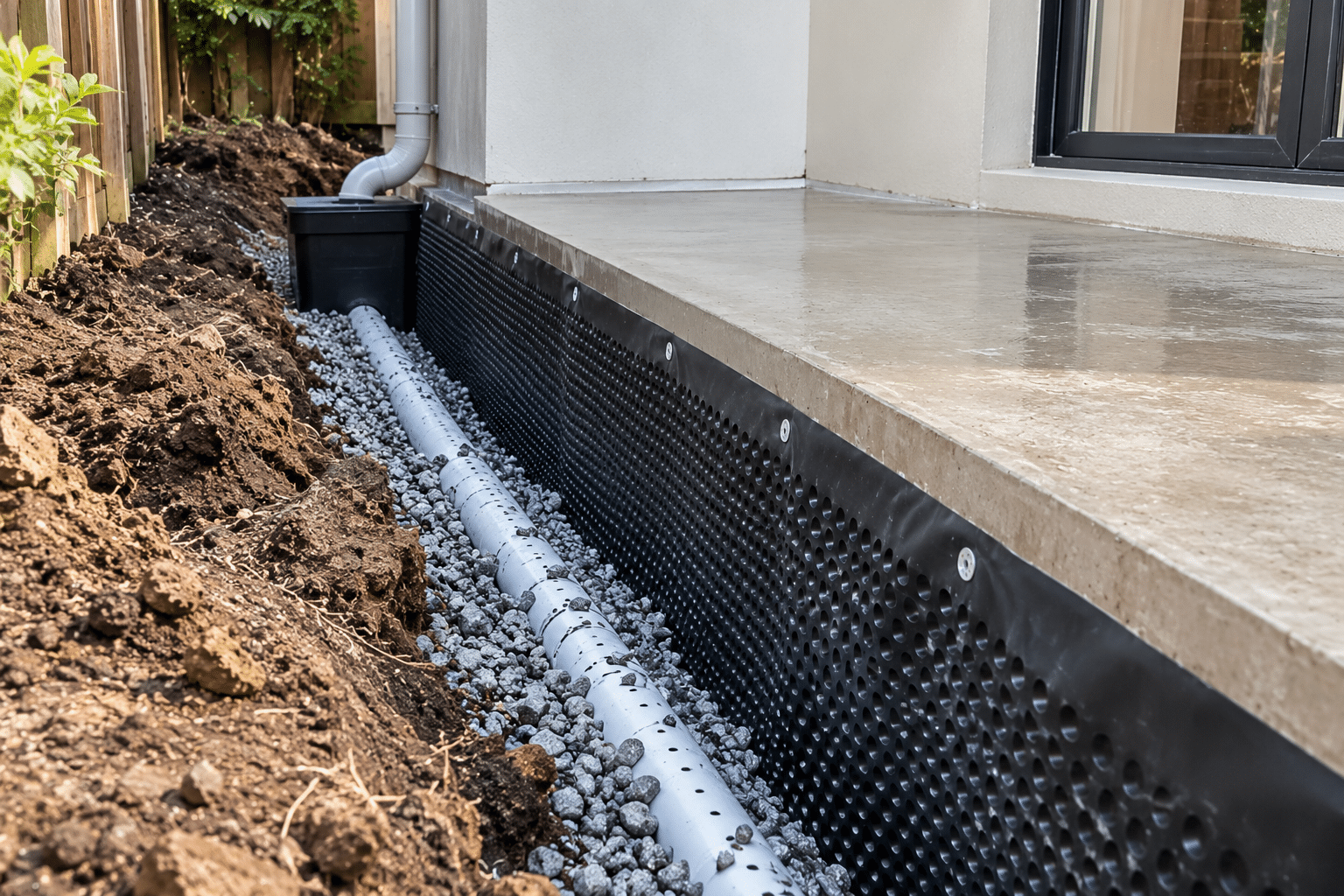
Slab type 02

Waffle Pod Slabs

Waffle pod slabs sit on a grid of polystyrene pods with concrete ribs between them, and the exposed pod edge around the perimeter needs careful detailing. We seal every penetration with collars and install a perimeter system suited to the edge profile, keeping the inspection zone clear so termites cannot travel unseen between the pods and the external wall.

Slab type 03

Suspended Timber Floors

Suspended timber floors leave a crawl space beneath the house, so protection works at each pier, stump and service line rather than across a slab. Ant caps go on every support, attached slab areas such as laundries receive collars, and the subfloor is kept ventilated and accessible so a routine inspection can reach every corner.

Slab type 04

Step-Downs and Control Joints

Step-downs between floor levels and control joints that let the slab move are two of the most overlooked weak points in a build, and termites can follow them straight through the concrete. We seal them with stainless steel mesh or a compatible joint system before the pour, so the barrier stays continuous across every change in level.

Building soon?

Book Your Termite Barrier Installation Before the Pour

Share your plans and pour date, and we will recommend the right physical system for your slab with a fixed written quote.

Stage by stage

Step-by-Step Physical Barrier Installation for New Homes

Physical barriers have to go in at exactly the right moment, because most of them end up cast inside or beneath the concrete. Each visit is timed with your plumber, slab crew and bricklayer, so termite protection for new homes is never rushed or skipped. A typical installation follows these four stages.

Foundation trench and prepared concrete slab area during the construction stage of termite barrier installation
Before the concrete pourBarrier placement is coordinated with the foundation and plumbing stages.
01

Plan Review and System Selection

After studying your slab design, plumbing plan and site falls, we recommend the combination of mesh, stone, membrane and collars that suits the build. You receive a written quote and a clear schedule showing when each stage happens.

02

Collars Fitted After Services Set-Out

With every pipe and conduit positioned by your plumber, we fit collars to each penetration and check them against the plans. This is the stage where most entry points are closed, so nothing is left to chance before the slab crew arrives.

03

Mesh or Membrane Laid Before the Pour

Next, we install mesh, graded stone or membrane across joints, step-downs and any areas specified for full coverage. We sign this stage off before the certifier's pre-pour check, so the concrete can be placed on schedule.

04

Inspection Zone and Durable Notice

After the walls go up, we check the slab edge and cavity details, confirm the inspection zone is clear and fix the durable notice inside your meter box. Your certifier then gets the installation certificate and product details needed to issue the occupation certificate.

Why go chemical-free

Benefits of Chemical-Free Termite Protection for Sydney Families

Chemical-free termite protection appeals to families who want long-term peace of mind without treated soil around the house. Here is what a physical system offers over the life of your home.

No Termiticides Around Your Home

Mesh, graded stone and collars rely entirely on their physical structure, so there is no treated soil zone beneath children's play areas, vegetable gardens or the spots where pets love to dig.

Nothing to Top Up While It Stays Intact

Unlike a chemical zone, a physical system does not wear down over time. As long as later building work does not damage it, protection continues without any scheduled re-treatment.

Designed to Last for the Life of the Slab

Stainless steel and graded stone do not rust, rot or break down in Sydney soils, so protection installed today is built to stay in place for as long as the slab beneath your home.

A Better Fit Near Bushland and Waterways

For blocks close to creeks, drainage lines or native bushland, a physical system avoids placing termiticide in soil that may drain towards sensitive environments.

Best fit

Is a Physical Barrier the Best Termite Protection for You?

There is no single best termite protection for every property. A physical system is an excellent choice in the right situation, but it is not always the most practical one. This quick guide shows where each approach fits.

A physical barrier suits you when:
  • You are building new or adding a fresh slab
  • You want no termiticides in the soil
  • Your block sits near bushland, a creek or a vegetable garden
  • You prefer protection with no scheduled top-ups
VS
Consider a chemical or reticulated system when:
  • The slab is already poured and cannot be reached
  • Paths and paving surround the whole house
  • You want a zone that can be renewed through pipes
  • An active colony needs treating first

Many Sydney builds combine both, with collars at every penetration and a chemical perimeter around the edge. Compare every option on our termite barrier Sydney page, or see how termite reticulation lets you renew a chemical zone without digging.

Extending or renovating

Termite Protection for Extensions and Home Renovations

Termite protection for extensions is easy to overlook once a home is already built. Any new slab, room or granny flat needs its own system, and it has to connect with whatever already protects the original structure. A post construction termite barrier cannot be slid under an existing slab, but it can fully protect the new work.

Linking New Work to Existing Protection

The join between a new slab and the old one is where extensions most often fail. We identify the existing system from the durable notice or an inspection, then install mesh, collars or a compatible barrier so the new and old protection meet without a gap. The durable notice is then updated to record every change for future owners.

Sealing New Pipes Through an Older Slab

Renovations often mean new plumbing cored through a slab that was sealed years ago. Each fresh hole is an open path for termites unless it is collared or sealed. We fit retrofit collars or sealant systems to new penetrations and, where needed, recommend termite treatment in Sydney for any activity uncovered during the work.

Why choose us

Why Builders Trust Our Physical Barrier Installers in Sydney

Physical systems only work when every detail is right on the day, which is why builders and owners across Sydney rely on our team.

Licensed and Insured Team

Every installation is carried out by licensed, insured pest managers who follow AS 3660.1 alongside the manufacturer's specifications for each product.

Coordinated With Your Trades

We book each stage around your plumber, slab crew and bricklayer, confirming attendance in advance so no pour or inspection is held up.

Paperwork Your Certifier Needs

Durable notice, installation certificate and product information arrive as one package, ready for your certifier and the occupation certificate.

Honest Advice on Every Option

If a chemical or reticulated system suits your site better, we will tell you. Our recommendation always follows the slab design, never a preferred product.

What to expect

What You Get With a Physical Termite Barrier Installation

Physical termite barrier installation is planned around your build, from the first plumbing set-out to handover.

A System Matched to Your Slab

We review your plans and select the right combination of collars, under-slab membrane, stainless steel mesh or graded stone for your slab type and site.

Installation Staged Around Your Build

Collars and membranes go in after the plumber sets out the services and before the pour, with each visit coordinated with your builder, plumber and concreter.

Paperwork for Your Certifier

Installations are completed to AS 3660.1, and you receive the durable notice your certifier needs, recording the system installed and when it should be inspected.

Common questions

Physical Termite Barrier FAQs for Sydney Homeowners

What is a physical termite barrier?

A physical termite barrier is a layer of material termites cannot chew through, move or pass, such as stainless steel mesh, graded stone or a termite-resistant membrane, installed in and around the slab. It shuts off hidden entry points and leaves termites exposed, so a yearly inspection can spot them.

Can termites chew through stainless steel mesh or a membrane?

No. Marine-grade stainless steel mesh and graded stone resist termite jaws entirely, and quality membranes are made to resist them. What termites can do is travel around a barrier that has been damaged, covered or bridged, which is why the inspection zone must stay visible.

How long does a physical barrier last?

Stainless steel mesh, graded stone and cast-in collars are designed to last for the life of the slab while they remain undisturbed. Their lifespan is mainly shortened by later building work, such as new plumbing or landscaping that damages or covers the barrier.

Do mesh and membrane barriers need maintenance?

They need no top-ups, but they do need care. Keep the slab edge exposed, avoid building garden beds or paving over the inspection zone, tell us before cutting new pipes through the slab, and arrange a professional timber pest inspection every twelve months.

Is physical protection better than a chemical treatment?

Each suits different situations. Physical protection is ideal for new builds and families who want no chemicals in the soil, while a chemical treatment is usually the more workable option for a house that is already built. Many Sydney properties use both, with collars at penetrations and a chemical perimeter.

Can a non-chemical barrier be added to an existing home?

Only partly. Mesh or stone cannot be placed under a slab that is already poured, but new penetrations can be collared, extensions can receive a full physical system and ant caps can be fitted to piers under suspended floors. For complete perimeter cover, a chemical or reticulated system is usually added.

What affects the cost of physical termite protection in Sydney?

Pricing is shaped by the slab size and design, the number of pipe penetrations, how many joints and step-downs need sealing, and whether you choose collars with perimeter protection or full under-slab coverage. How many site visits your construction schedule requires will also shape the price.

Does a physical barrier meet NSW rules for new homes?

Yes. A physical system installed to AS 3660.1 is an accepted way to provide the termite management system the National Construction Code requires for new homes in NSW wherever the main structural elements could be damaged by termites. The installer must supply a durable notice and installation certificate.

Free quote, fast reply

Get a Physical Barrier Quote for Your Sydney Build

Tell us about your slab design and expected pour date, and we will recommend the right physical system with a fixed written quote. Renovating or extending? Send us the details, and we will plan protection that joins your existing system.

Forminator form 7159 renders here